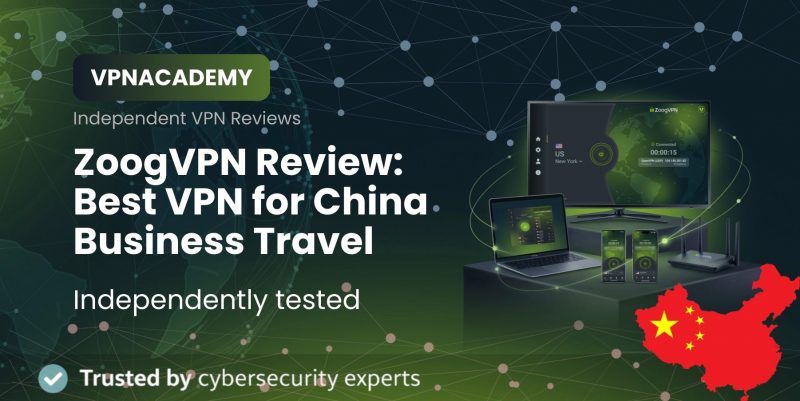
China can turn routine business communication into a connectivity problem. Services that teams rely on every day, from Gmail and Slack to Zoom and WhatsApp, may be inaccessible without the right setup, which is exactly why a VPN is important for business travelers in a way it isn’t for casual browsing.
This review tests ZoogVPN as a corporate VPN in China against a real brief: keep a whole travel team’s laptops and phones online through a trip to mainland China, backed by a verified track record against China’s filtering, real device headroom for a company account, and a jurisdiction and encryption standard that hold up when the traffic includes client contracts or financial data. If you’re weighing the best VPN for business use generally, the features that matter here apply well beyond China too.
ZoogVPN for Business — Quick Facts
- ✓Score: 9.4/10
- ✓From $2.49/month, Patras, Greece, outside the 14 Eyes
- ✓Shadow protocol confirmed working in China as of 23 July 2026
- ✓10 devices per standard plan; custom accounts for 100, 200 or 300+ devices
- ✓AES-256 encryption, split tunneling, automatic kill switch
- ✓100+ server locations, cross-platform including router-level setup
- ✓24/7 live chat, no-logs policy, 7-day money-back guarantee
Why a VPN Is Important for Business
China blocks Gmail, Google Drive, Google Calendar and Google Meet outright. WhatsApp, Facebook and Instagram are blocked. Zoom drops connections often enough that most companies stop relying on it inside the country, and Slack works inconsistently depending on the network. None of this changes based on why an employee is in the country.
A tourist without Instagram for two weeks shrugs and moves on. A business traveler without a working inbox misses a board call, leaves a signed contract sitting in a Drive folder that won’t open, or shows up to a client meeting without the deck stored on a server the hotel WiFi can’t reach. This is the core reason a business VPN earns its place in a travel policy: it keeps the trip’s actual work on schedule, not just its entertainment.
Hotel and conference WiFi add a second problem: unmanaged networks that most IT departments wouldn’t trust with a company laptop back home. Secure access to company resources, both in-office and remote, protects sensitive data from cyber threats and unauthorized access, thereby eliminating the possibility of financial loss or reputational damage from a single unsecured connection.
Benefits of a VPN for Business
China is the hardest test a business VPN faces. The features that make a provider worth using there are the same ones that matter for any company deploying a VPN across an entire workforce.
Secure remote access
Employees reach internal databases, cloud tools or a CRM from any network without exposing credentials to whoever else is on it, whether that’s a hotel lobby, an airport lounge or a client’s office WiFi.
End-to-end encryption
AES-256 encryption keeps traffic between devices and servers unreadable to anyone who intercepts it, which matters most on unmanaged hotel or conference networks carrying client contracts or financial data.
Split tunneling
Work traffic runs through the encrypted tunnel while local apps like maps or ride-hailing connect directly, so the VPN doesn’t slow down the parts of the trip that don’t need it.
Automatic kill switch
If the VPN connection drops, internet access cuts automatically instead of quietly falling back to an unprotected connection mid-transfer.
Geo-testing for ads and marketing
Marketing and ad teams get a separate use for the same tool: checking how a campaign, landing page or company site renders in a target region before launch, viewing it the way a local user would rather than guessing from a home-market view.
Cross-platform, unlimited-scale device coverage
Windows, macOS, Linux, iOS, Android, Android TV, Fire TV, Chromebook and router-level setups mean IT can standardize on one tool rather than managing separate solutions per device type, whether that’s protecting 10 devices or 300.
24/7 dedicated support
A connection problem at 2am local time, right before a 9am meeting, is where live chat earns its keep: a five-minute fix instead of a lost morning.
What VPN to Use in China (When the Trip Isn’t Optional)
Most consumer VPNs advertise a China feature and work unreliably the moment you land.
China’s filtering targets more than destination. Deep packet inspection systems scan for the handshake signature standard VPN protocols produce and drop the connection on sight, regardless of which server you picked. A VPN that works everywhere else in the world can go dark the moment you land in Beijing.
Finding the best VPN for traveling to China on business means checking for a few specific things most provider pages leave out: an obfuscation protocol with a recent, dated confirmation that it works inside China right now; a way to reach the app itself if the download or login domain gets blocked separately from the tunnel; enough device slots to cover a whole team without a second subscription; and a jurisdiction and encryption standard that make sense for devices carrying client data across a border.
ZoogVPN Review: A Corporate VPN in China
ZoogVPN’s answer to that checklist starts with a protocol most competitors don’t publish proof for, and a business plan built to scale past a single laptop.
The Shadow Protocol, With a Date Attached
Standard VPN traffic carries a recognizable handshake, and deep packet inspection systems in Shanghai, Tehran, and elsewhere are built to spot it and cut the connection before it establishes. ZoogVPN’s Shadow protocol wraps the tunnel in an obfuscated proxy layer, so the traffic reads as ordinary HTTPS instead of flagging as a VPN. Business plans can also fall back to OpenVPN, WireGuard, IKEv2, or ZoogTLS depending on the speed and security needs of a given office or branch.
The difference from most competitors’ China claims is the paperwork behind it. ZoogVPN publishes dated status checks for Shadow in China, Russia, Iran, Turkey, the UAE, and Qatar, all confirmed green as of 23 July 2026. A timestamp matters here because filtering technology shifts month to month, and a provider’s China page from eighteen months ago tells you nothing about next week’s trip. DigitalCruch, a China-based outlet that tests VPNs from inside the country, rated ZoogVPN’s connection among the more stable options for reaching blocked sites there, even on the free tier, alongside Geph and Psiphon.
A Backup Route When the App Itself Is Blocked
Some networks block the VPN provider’s app or login domain directly, which stops you from reaching the tunnel at all, protocol aside. ZoogVPN’s manual IP resolution handles that case: support sends a server IP address, you enter it under Preferences, and the app connects without touching the blocked domain. It has to be set up before departure, since the support channel and download page sit behind the same block once you land. The site at zoog.pro also stays reachable even when China blocks the main ZoogVPN site.
Device Scale and Custom Business Plans
A standard ZoogVPN plan covers 10 simultaneous devices, enough for a laptop, a phone, and a couple of backup connections on one account. Companies sending a full sales team or a multi-branch operation into the region can scale past that: ZoogVPN sets up custom plans for 100, 200 or 300 devices under one corporate account, arranged directly with the business team rather than through the consumer checkout flow. Laptops, smartphones and IoT devices can all sit under one subscription, and easy management tools let IT monitor usage and connections across the whole team from a single dashboard.
This flexibility is also why ZoogVPN comes up for industries well beyond travel: IT and software teams securing access to cloud services and internal systems, finance and banking teams protecting transactions and compliance, healthcare teams maintaining HIPAA-relevant data protection for remote access, and eCommerce or retail teams checking how sites and pricing pages appear across regions.
Jurisdiction, Encryption and Proof of a No-Logs Policy
ZoogVPN operates as Zoog Services IKE out of Patras, Greece, outside the Five, Nine and Fourteen Eyes intelligence-sharing agreements. Paid plans run 256-bit encryption with a 2048-bit hash key, plus DNS and IP leak protection so no identifying data escapes the encrypted tunnel. The no-logs claim has independent backing behind it: ZoogVPN’s warrant canary reported zero national security letters, zero gag orders, and zero government warrants as of May 2026, and the Android app passed a MASA Level 2 assessment from an authorized lab in January 2026, earning Google Play’s Verified badge. For anyone carrying client contracts or financial records on the trip, that’s the part of the spec sheet worth reading twice.
Staying Connected Before the VPN Even Matters
A VPN only helps once the device has a data connection, and airport SIM kiosks or last-minute roaming plans are their own source of trip delays. ZoogVPN bundles a lifetime eSIM covering 170 countries and 200 networks, China included, that runs alongside an existing SIM rather than replacing it. A small detail, but it removes one more thing that can go wrong between landing and the first meeting.
Pricing for Business Use
ZoogVPN’s standard paid plan runs $2.49 a month on the two-year term, billed as $59.99 for 27 months, with unlimited bandwidth included. A free tier exists too: 5 servers, 10GB a month, one device, 128-bit encryption, no card required and no expiry date. It works as a way to test the app before committing, but the single-device cap and lighter encryption make it a trial rather than a business setup. For teams needing 100+ devices, pricing is arranged directly with ZoogVPN’s business team rather than through the standard checkout. The refund window is the one place ZoogVPN trails the field: 7 days against the 30 most competitors offer, so testing the Shadow connection from an actual China-adjacent network in the first week matters more here than it would elsewhere.
Before You Fly
Set up Shadow and save the manual IP address under Preferences before departure. The sign-up page, download link and support chat all sit behind the same firewall once you land, so anything you’ll need has to be configured first. For routing, Singapore, Japan and Taiwan servers give the shortest path out of mainland China.
Check your company’s IT and data policy before the trip too. Some employers restrict which tools can touch client data abroad, and it’s a short conversation that avoids a compliance headache later.
Where ZoogVPN Wins, and Where It Doesn’t
A fair review names the limits along with the wins.
Why it works as a business VPN for China travel
- ✓Shadow protocol backed by dated, published status checks, not a blanket claim
- ✓Manual IP resolution for networks that block the app domain itself
- ✓Custom device plans that scale from 10 to 300+ for travel teams
- ✓Split tunneling, kill switch and DNS/IP leak protection built in
- ✓Greek jurisdiction outside the 14 Eyes, backed by a live warrant canary
- ✓MASA Level 2 certified Android app with Google Play’s Verified badge
- ✓Lifetime eSIM covering China alongside an existing SIM
- ✓24/7 live chat with response times measured in minutes
Where it falls short
- 7-day refund window, versus the 30 days some competitors offer
- Free tier caps at one device and 128-bit encryption, fine as a trial but not a business setup
- Total server count is smaller than the largest global VPN networks, though the routes that matter for China (Singapore, Japan, Taiwan) are covered
Verdict: Is ZoogVPN the Best VPN for China Business Travel in 2026?
The scenario from the top of this review is the actual test, and ZoogVPN passes it with room to spare.
A VPN for China business travel has one job: keep the tools a team uses running when the network is trying to stop them. ZoogVPN clears that bar with a protocol that has a published, dated track record in China rather than a marketing promise, a backup connection method for networks that block the app itself, and device and business plans that scale from a single laptop to a full travel team of 300+ devices. The jurisdiction, the warrant canary, and the MASA certification give the security claims something to point to beyond the provider’s own word.
At $2.49 a month, it’s priced like a consumer tool but built with the kind of verification a corporate IT policy wants to see. The 7-day refund window is the one number worth remembering: test the connection from a China-adjacent network early, inside that first week, and the rest of the trip runs the way it would from any other hotel room.
Ready to Stay Connected in China?
Set up Shadow before you fly and keep your team’s inbox, calls and files running the way they do everywhere else.